
One contract covers every market you sell in
The channel changes by country, because it has to. The contract, the integration and the reporting do not. That is the difference between adding a channel and adding twelve suppliers.

Trusted by teams that sell everywhere







You chose email because one contract covered every market. Now messaging does too
Selling in several countries used to mean a messaging supplier in each one. With 2way, it's one.
Turn traffic you already pay for into contacts you own
Most visitors leave without buying or leaving a contact. A popup or a small teaser asks at the right moment, with a reward, so you can reach them again without paying for another visit.
Up to 5% of website traffic becomes a verified contact
Live in 48 hours, with no changes to your site
Automatic reminders for unused codes and abandoned baskets
A different channel and language per market

See what your traffic could turn into
Enter your store count and monthly website visits. The estimate uses conservative assumptions, and no email is required.
We assume 500 verified contacts per store per month, based on a live fashion retail deployment.
We assume 1% of visits become a verified contact. Our best deployments reach 5%, so treat this as a floor.
verified, consented contacts per month
added to your database over twelve months
per month in store
per month online
Based on averages from live deployments, not a forecast for your business. Real numbers depend on placement, offer and market, which is what a pilot settles.
What this looks like when you have to defend it
A committee decision needs arguments that survive being repeated by someone else, in a room you are not in.
Revenue traced to the contact
Each sign-up gets an individual code, tracked to a completed purchase. Channel contribution stops being an argument about attribution models and becomes a column in a report.
A smaller base, and that is the point
Compare revenue per contact, not list size. One retailer sent identical content to an 11,000-contact legacy base and to 570 contacts collected through 2way: 4% click-through against 12%.
An asset, not a campaign line
Every number was confirmed by its owner at sign-up, so the base holds contacts you can reach, and the cost of collecting each one is paid once, not per campaign.
Brand risk handled in the configuration
Sending windows per market, quiet hours per US state, opt-out honored across every channel in one click. Nobody receives a message at 11pm, and anyone who wants out is out immediately.
Every message approved before it goes
Campaign calendars are agreed in advance and each message is submitted to your brand team. Nothing reaches your customers that you have not seen, in any market.
Legal reviews one document
One DPA with Standard Contractual Clauses, a published processor chain and a consent record per contact. Not twelve local regulations for someone to interpret.
350,000 messages, and the replies land in the agent's inbox
Custom Ink sends order and shipping messages through 2way in the United States. When a customer replies, the message arrives in the Text inbox the agent already works in, and the answer goes back out as an SMS. The customer never learns that two systems are involved.
order and shipping messages sent through 2way
of recipients reply, and every reply reaches an agent
panel for the agent, covering both web chat and SMS
carrier registrations for their team to manage
The price per message is not where this is won or lost
A cheap message to a number nobody verified costs more than an expensive one to a customer who opted in. The interesting number is what it costs to acquire a contact you can reach for the next two years.
01
You are already paying to acquire these people
Media budget brings someone to the site or into the store. Without a number, reaching them again means buying them again.
02
Collection runs on traffic you already have
No new media spend is required to start. The popup and the sticker sit on top of footfall and sessions that exist today.
03
The base keeps producing
A verified contact stays reachable, so the acquisition cost is spread across every campaign that follows rather than charged to one.
04
Commercial terms are set per contract
On markets, channels and volume, and we discuss them on the first call rather than after the third.

Keep the conversation going after checkout
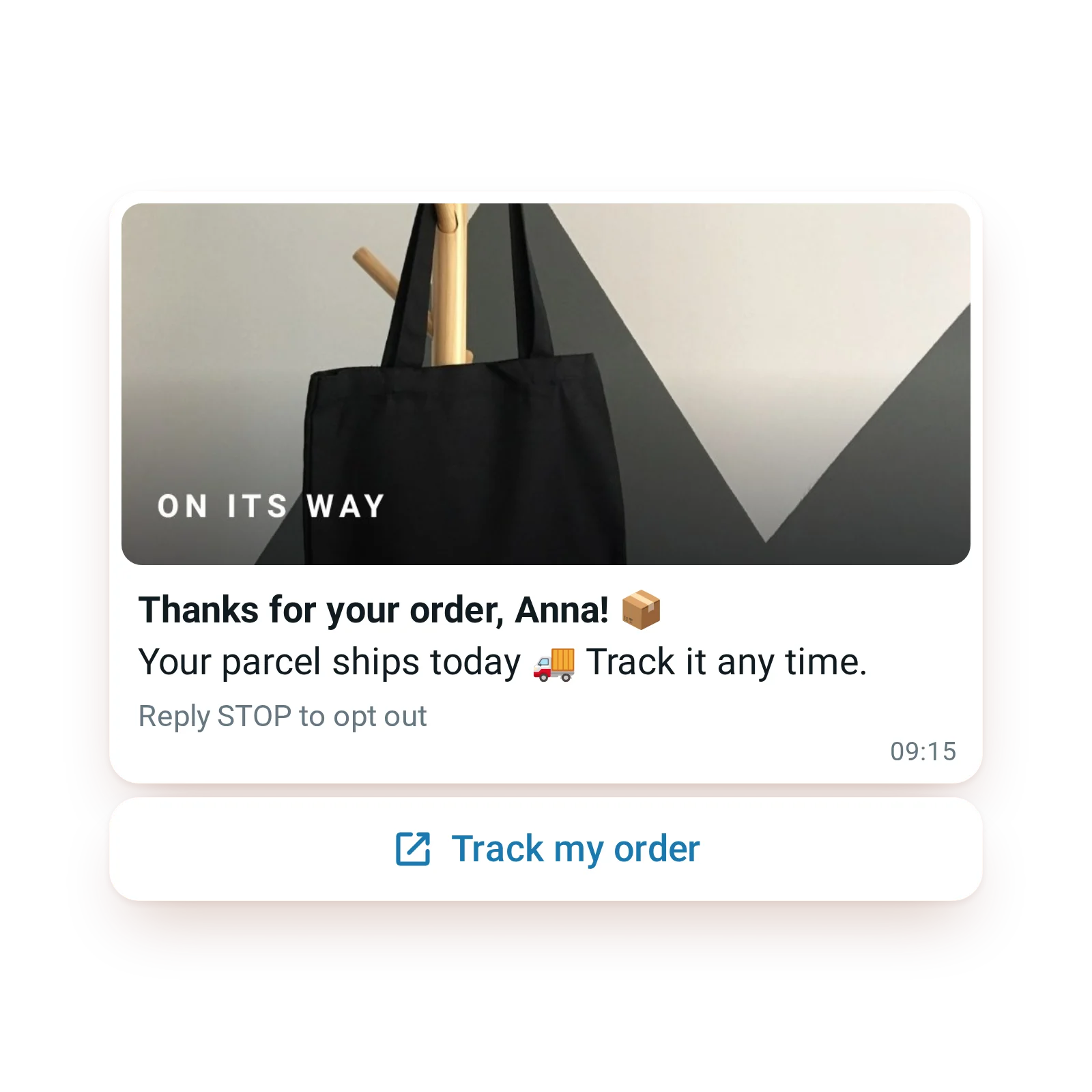
Send order updates, ask for a review and suggest what goes well with the purchase. Replies land in the same chat, so one order turns into the next.
One market, one KPI, one written report
Enterprise organizations should not sign a multi-year agreement on the strength of a deck. A pilot is scoped to a fixed period at a fixed price, and it does not roll into a longer commitment on its own.
01 Pick the market
Usually the one where the current setup hurts most, or the one where a channel is uncontested. We will tell you which we would choose and why.
02 Agree the number
One KPI, agreed in the first workshop. Contacts collected, revenue attributed, or basket value against a holdout group. Not a dashboard of everything.
03 Decide on the report
A written report within five business days of the pilot ending, with the comparison against your own control group. You approve the rollout on that, or you do not.
Questions ecommerce teams ask
They do, and that is exactly the problem. Each one knows one market and none of them owns the program. Twelve contracts, twelve integrations, twelve sets of numbers that do not add up, and nobody who can tell you whether Spain outperformed Poland. We are one contract across all of them, and we still pick the channel country by country, because that part does have to stay local.
Next to them, not against them. Your automation platform decides when to send. We make sure there is someone real on the other end, and that the message is allowed to reach them in that country. Contacts and consents sync into your existing stack through Zapier, our webhooks or the API.
No. Meta paused WhatsApp marketing templates to US numbers in April 2025 and has not lifted the pause. For the United States the channel is SMS and MMS, with 10DLC brand and campaign registration through TCR, which we handle. WhatsApp and Viber are the right choices across Europe, market by market.
Some do. Ours runs only where you decide, and it gives something back: a code, early access, whatever fits your offer. If it does not convert, you switch it off in a day.
Standard online deployment is 48 hours: a tag in Google Tag Manager and hosted sign-up pages on your subdomain. Nothing is rebuilt on your site. A multi-market pilot with number registrations, WhatsApp verification and CRM integration takes around three weeks from signature to first send, because carrier and Meta registrations set the pace, not our engineering.
No. 2way brings customers to it: the sign-up can lead to your app download, and if a customer is not ready on the spot, you can remind them later. It also reaches the customers who would never download a store app.
From the blog
.png)
.png)
Start with one market. Decide on the numbers
We would rather prove it on one of your markets than argue it in a deck. Thirty minutes to scope the pilot.
