
Conversion is one of the most critical performance indicators in commerce, both online and offline. It represents the percentage of individuals who visited a store, browsed a website, or engaged with a brand and subsequently completed a purchase or performed another desired action. Despite the fact that measurement and optimization tools are more accessible today than ever before, many organizations continue to face the same persistent challenge: traffic is present, interest is evident, but sales growth remains disproportionate.
The underlying causes are numerous, ranging from a misaligned product offering and a suboptimal purchasing experience, to an absence of timely and relevant customer communication. There is no single universal solution that applies across all industries. However, there are specific areas in which targeted interventions consistently produce measurable and repeatable results. This article examines those areas in detail, within the context of both online and physical retail, and outlines the mechanisms that drive performance.
Conversion is a Process
The conventional understanding of conversion reduces it to a transaction: a customer purchased, therefore a conversion occurred. This framing, however, is increasingly insufficient. In an omnichannel environment, conversion encompasses an entire sequence of micro-actions that lead to a purchase: a newsletter subscription, a link click, the application of a discount code, a return visit to the website after several days. Each of these events provides insight into where a customer stands within their buying journey and what may prompt them to complete the transaction.
Brands that define conversion exclusively in terms of the last click forfeit the ability to influence the entire customer journey. Those that track behavior at every stage and respond with contextually appropriate communication at precisely the right moment gain a genuine and sustainable competitive advantage.
In an environment of rising customer acquisition costs (CAC), conversion rate optimization has become one of the highest-return marketing activities available. Rather than increasing advertising spend to generate additional traffic, organizations should first determine whether existing traffic is being fully leveraged.
It is also important to distinguish between transactional conversion and relational conversion. The former refers to a completed purchase. The latter encompasses subscription, engagement, and return visits. Organizations that focus exclusively on transactions must continuously absorb the cost of acquiring new customers. Those that cultivate relationships with existing customers and maintain ongoing communication retain access to a more cost-effective and higher-performing sales channel than any paid campaign can provide.
Effective optimization is a continuous cycle: measure, test, implement changes, and measure again. Organizations that approach this cycle with rigor and consistency achieve outcomes that cannot be replicated through one-off initiatives.
Contact Database as the Foundation for Online Sales Growth
Before a brand can optimize conversion, it must establish direct access to its customers. This extends beyond website traffic. It requires a contact database that can be re-engaged with relevant offers at precisely the right moment.
In e-commerce, over 80% of traffic now originates from mobile devices. This is a critical data point, as it directly impacts the design of contact acquisition tools. A traditional full-screen popup that appears immediately upon page entry may perform adequately on desktop but frequently becomes an obstacle on mobile. When a user is browsing products on a smartphone and an element abruptly obscures the screen, the outcome is the inverse of what was intended: the user dismisses the popup rather than subscribing.
A more effective solution - particularly on mobile - is the teaser: a compact interface element displayed discreetly at the bottom of the screen. It does not obstruct content, does not interrupt browsing, and appears only when the user actively chooses to engage with it. This deliberate interaction is precisely why teaser conversion rates can reach as high as 10%. The user makes a conscious decision rather than reacting to an interruption. Intent is elevated, and results reflect that accordingly.
On desktop, the popup remains an effective tool - provided it is displayed at an appropriate moment rather than upon every page entry. Display rules can be configured to trigger after a specified amount of time on page, after a defined scrolling threshold, upon exit intent, or during a return visit. These parameters ensure the popup is served to users who have already demonstrated genuine interest, and those are precisely the users who convert. A well-configured popup achieves an average conversion rate of up to 3%, which at meaningful traffic volumes translates to hundreds of new contacts per month. Variant testing and ongoing optimization of rule configurations are strongly recommended.
Why Double Opt-In Delivers Superior Results Over a Larger Database
The critical variable is not merely the volume of contacts collected, but their quality. This is where the double opt-in mechanism demonstrates its full value: after entering a phone number, the user receives an SMS containing a one-time verification code, and only upon entering that code is the number added to the database. As a result, the list is comprised exclusively of active, verified contacts. The mechanism also functions as an automated safeguard against duplicates: the system verifies whether the number already exists in the database before adding it. Approximately 95% of users who initiate this process complete it. The resulting database is clean, current, and fully compliant with GDPR.
A brand that builds its database with this mechanism in place incurs lower campaign costs (fewer inactive contacts to manage), achieves higher engagement rates, and is able to conduct more precise, targeted communications. Database quality translates directly into conversion performance across every subsequent campaign.
There is also a meaningful psychological dimension to this mechanism. A user who has completed a two-step verification process has provided informed, intentional consent - they did not subscribe accidentally. This higher level of intent translates into greater engagement with future campaigns delivered to that contact.
How Physical Retail Can Build a Digital Contact Database
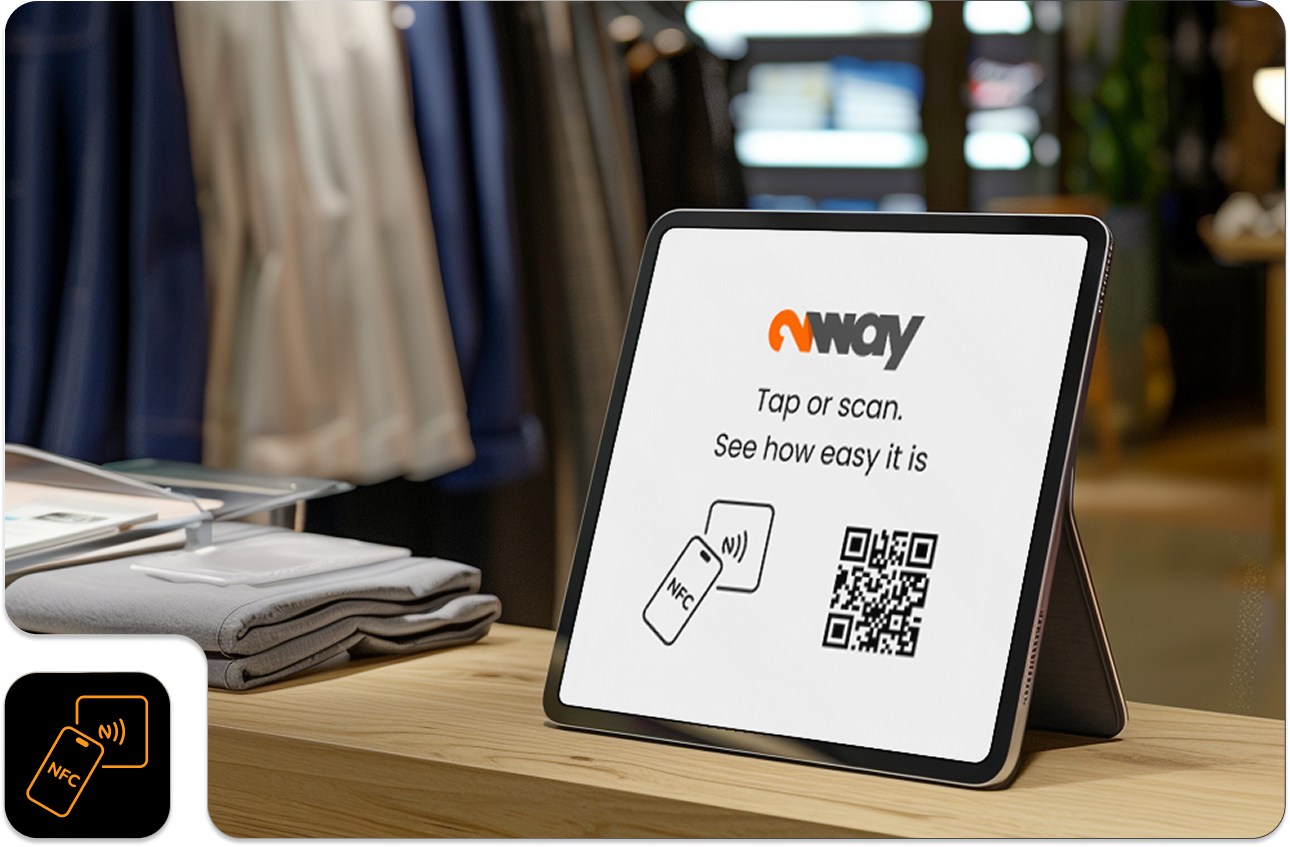
Physical stores generate substantial foot traffic that can today be effectively converted into a digital contact database. NFC and QR technologies enable the transformation of an in-store visit into an enduring relationship between the customer and the brand. A sticker placed at the checkout, fitting room, product shelf, or store entrance can convert a visitor into a contact in the brand's database within seconds.
The interaction is both simple and frictionless. With NFC, the user simply holds their phone near the sticker; the device automatically opens the registration page. QR operates with equal efficiency wherever a camera can be directed: on stickers, posters, leaflets, digital displays, packaging, point-of-sale materials, parcel inserts, or outdoor advertising. Both channels deliver comparable results, and the choice between them depends on context and the preferences of a brand's customer base.
2way stickers support both NFC and QR simultaneously, meaning a single physical solution serves all users regardless of device model. Upon tapping or scanning, the customer is directed to a landing page with a registration form, and after confirming their number via SMS code, their contact is added to the system.
Registrations Generated per Physical Location
What differentiates this approach from other offline contact acquisition methods is the precision of the data it generates. Each sticker or QR material carries a unique identifier, enabling the brand to see exactly where each registration originated - from which specific sticker in a given store, from which city, and from which material format. For organizations operating a network of physical locations, this data enables direct comparison of location performance, meaningful analysis, and optimized placement of materials. If a checkout sticker generates twice as many registrations as one positioned at the entrance, subsequent rollouts can immediately prioritize the higher-performing placement.
Results from 2way NFC and QR sticker deployments indicate an average of approximately 30 registrations per day from a single location. In high-performing locations, that figure reached up to 60 registrations per day. At the scale of a physical retail network, these numbers rapidly compound into a database of tens of thousands of contacts - built without any incremental online advertising spend.
Individual Discount Codes
The modern approach to discount codes centers on full traceability. Through the 2way platform, every user who registers receives a unique code assigned exclusively to their account. This enables the brand to track not only how many codes were redeemed, but by whom, when, and what revenue they generated. This transforms the discount code into a fully functional analytical instrument.
The practical applications are extensive. If a user has registered and received a code but has not used it within a defined period, the system can automatically dispatch a reminder - the first after seven days, the second after three weeks. These sequences recover sales that would otherwise have been lost.
A particularly compelling use case is the integration of discount codes with cart behavior. If a customer entered their code in the order form but did not complete the transaction, the system is able to detect this and trigger an automated message. Between 4 and 24 hours later, the customer receives an SMS reminder about their abandoned cart along with an incentive to return. In the fashion, beauty, and e-commerce sectors, this mechanism consistently ranks among the most effective methods of recovering abandoned purchases - and abandoned cart recovery remains one of the most financially significant challenges in online retail.
SMS Marketing by the Numbers
Email marketing served as the dominant channel of marketing communication for many years. It remains relevant, but its effectiveness has been in steady decline: open rates currently hover around 20–25%, and click-through rates are significantly lower still. Compounding this are growing challenges with spam filters and widespread list attrition. For many organizations, email marketing has become an increasingly marginal revenue channel despite consuming a substantial share of marketing budgets and team resources.
SMS operates on fundamentally different principles. A text message is delivered directly to the recipient's phone - with no algorithmic filtering, no spam folder, and no requirement to open an application. According to 2way data, 97% of SMS messages are read within the first three minutes of delivery. Click-through rates in SMS campaigns are 6 to 8 times higher than in email.
A customer who has voluntarily registered and verified their number has given explicit consent to receive communications. Brands should honor that consent by sending messages only when there is something of genuine value to convey - not by inundating the customer with daily notifications. Well-managed SMS communication builds a lasting relationship. Frequency, content, and send timing are all critical variables, and all three can be continuously optimized based on data from prior campaigns.
Link Shortener: Lower Sending Costs, Richer Recipient Data
Links are a central element of promotional SMS messages - and more specifically, how those links are shortened. A compressed link occupies significantly fewer characters, which has a direct and measurable impact on sending costs.
The 2way link shortener operates on the brand's own domain. This means that rather than a generic URL, the recipient sees a link that incorporates the brand name - reinforcing message credibility in the eyes of the customer.
Behind the shortened link, the brand can embed a discount code, a personalized offer page, or a barcode ready for in-store scanning. The shortener also detects the operating system of the device and can automatically route the user to the appropriate destination - for example, the App Store or Google Play, if the brand operates a mobile application.
Conversion is the Result of Deliberate Decisions
Conversion is the result of decisions a brand makes before a customer ever reaches its website or walks through its doors. The tools discussed in this article are components of an integrated system. The teaser collects contacts on mobile; the popup supplements the database on desktop; the NFC sticker converts physical foot traffic into digital leads; the discount code activates purchasing intent; and SMS automation delivers the right message at the moment it has the greatest probability of driving action.
Frequently Asked Questions about Boosting Conversion Rates in Physical Stores and E-commerce
What is the difference between transactional conversion and relational conversion?
Transactional conversion is a completed purchase. Relational conversion covers the steps that precede and follow it: a newsletter subscription, a link click, a return visit, a discount code application. Brands that measure only completed purchases lose visibility into where customers drop out of the journey and what would bring them back. Tracking both types of conversion makes it possible to intervene at the right stage rather than only at the end.
Why does a teaser outperform a popup on mobile devices?
A popup that covers the screen on a smartphone interrupts browsing and typically produces an immediate close response. A teaser sits at the bottom of the screen without obscuring content and waits for a deliberate tap from the user. That deliberate action reflects higher intent, which is why teaser conversion rates can reach 10% on mobile, compared to up to 3% for a well-configured desktop popup. With over 80% of e-commerce traffic coming from mobile devices, the teaser is the more consequential tool for the majority of visitors.
Why does database quality affect conversion more than database size?
A larger database that contains inactive, unverified, or non-consenting contacts produces lower delivery rates, lower engagement, and higher cost per converted customer. A smaller database where every contact verified their number at sign-up and gave deliberate consent performs better across every campaign metric. The double opt-in mechanism ensures that only active, verified contacts enter the database, which means every subsequent campaign starts from a stronger foundation.
How do individual discount codes function as an analytical tool?
A unique code assigned to each contact creates a traceable line between a specific sign-up and a specific purchase. The brand can see who redeemed the code, when, and what revenue resulted. Contacts who received the code but did not act on it can be targeted with automated reminders at seven and twenty-one days. Contacts who entered the code at checkout but did not complete the transaction can receive an abandoned cart recovery message hours later. The code turns a promotional incentive into a measurement instrument that operates continuously without manual intervention.
What does a branded short link add beyond reducing character count?
A standard link shortener replaces a long URL with a generic short one. A branded short link incorporates the brand's own domain, which signals to the recipient that the message is legitimate before they click. Beyond credibility, the link tracks individual clicks, detects the recipient's operating system to route them to the correct destination, and can carry embedded discount codes or personalized offer pages. The character saving reduces sending costs directly, and the tracking data feeds segmentation for every campaign that follows.
More from the blog


See what your own stores would collect
We'll set up a pilot placement in one of your locations and show you the verified contacts it produces, before you commit to anything wider.
