How to Increase In-Store Conversion Through Offline Interaction
Physical retail has a conversion problem that does not show up cleanly in any report.
It is not the product. It is not the pricing. It is not even the store experience. It is the gap between a customer who is interested and a customer who is reachable, and how much can go wrong between the two.
The moment most brands are not capturing
A customer walks into a store in a considered state of mind. They came for a reason. They have some level of intent, whether it is to browse, to compare, or to buy. That intent is real and it is present, but it is also temporary. It lasts as long as the visit. When they leave, it does not carry over to any system, any channel, or any follow-up sequence.
This is the in-store conversion problem in its simplest form. Not that the visit did not happen, but that the brand has no way to continue the conversation after it ends.
The reasons a customer leaves without buying are rarely permanent. The size was not available. The queue was long. They wanted to think about it. They needed to check with someone. None of those barriers are final. Most of them dissolve within 24 hours. But by the time they do, the brand has no presence and no path back to that customer.
Where contact is lost
Retail brands have invested heavily in tools designed to build long-term customer relationships. Loyalty programmes, branded apps, membership schemes. These exist for good reason and they work well for the customers who use them.
The friction lives at the point of entry. Joining a loyalty programme typically means filling in a form. Name, email, phone number, sometimes an address. Creating a password. Confirming an email. The process is designed for a customer who has made a decision, who is already committed enough to spend several minutes on registration. It is not designed for the customer who is still deciding.
An app takes the same logic further. A download, an installation, an account creation. For a customer who loves a brand and visits regularly, that investment makes sense. For a first-time visitor standing in a store with no purchase yet behind them, the ask is disproportionate to the moment.
The result is a predictable drop-off. The customers who complete registration are already converted. The customers who are still in the consideration phase, the ones with the most to gain from a timely follow-up, are the ones the process loses.
The 30-second path
The mechanics of NFC and QR have quietly changed what is possible at this stage of the customer journey.
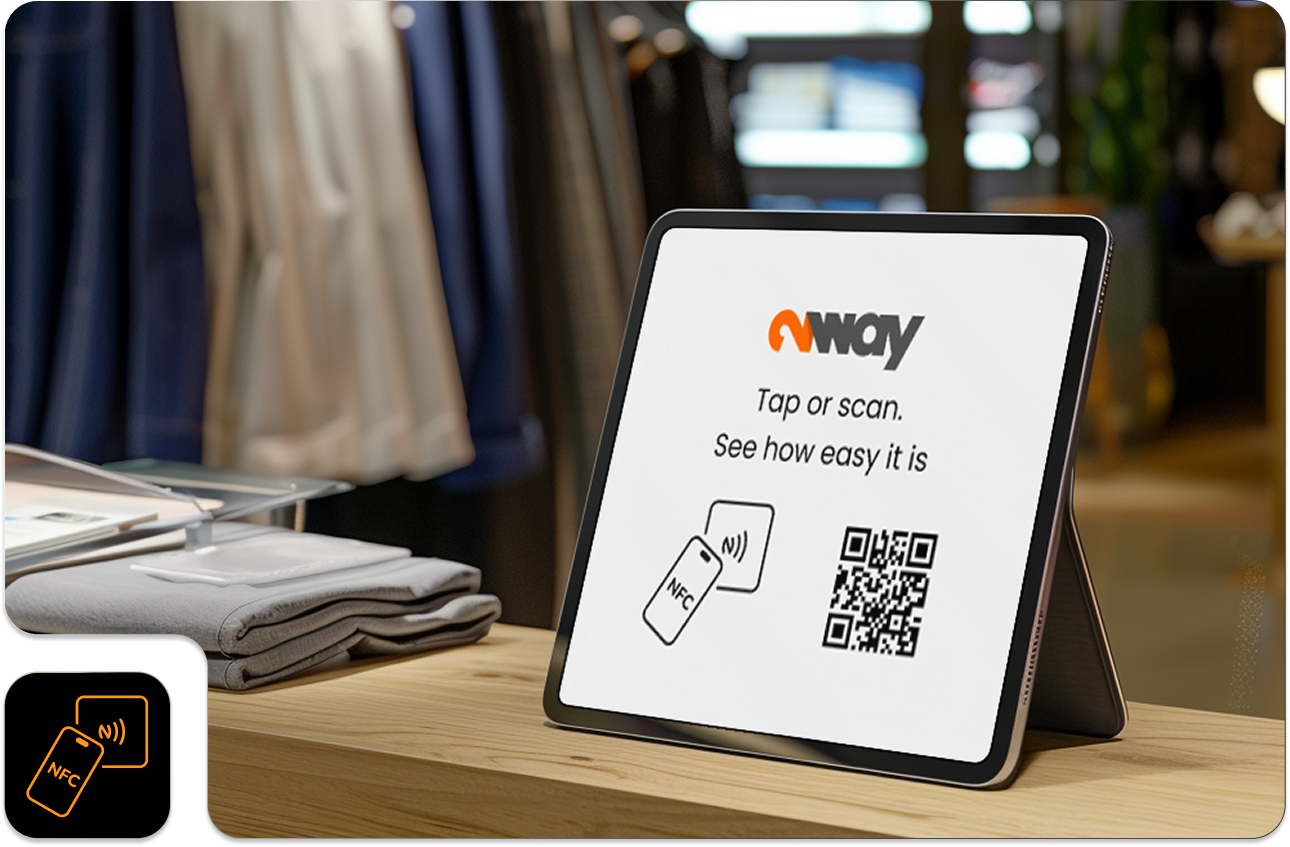
An NFC tag placed near a fitting room, at a checkout counter, or at a product display opens a sign-up page the moment a customer holds their phone close to it. No app required. No camera required. The page loads in seconds. The customer enters a phone number. A one-time verification code confirms it. The entire interaction takes around 30 seconds from the moment of contact.
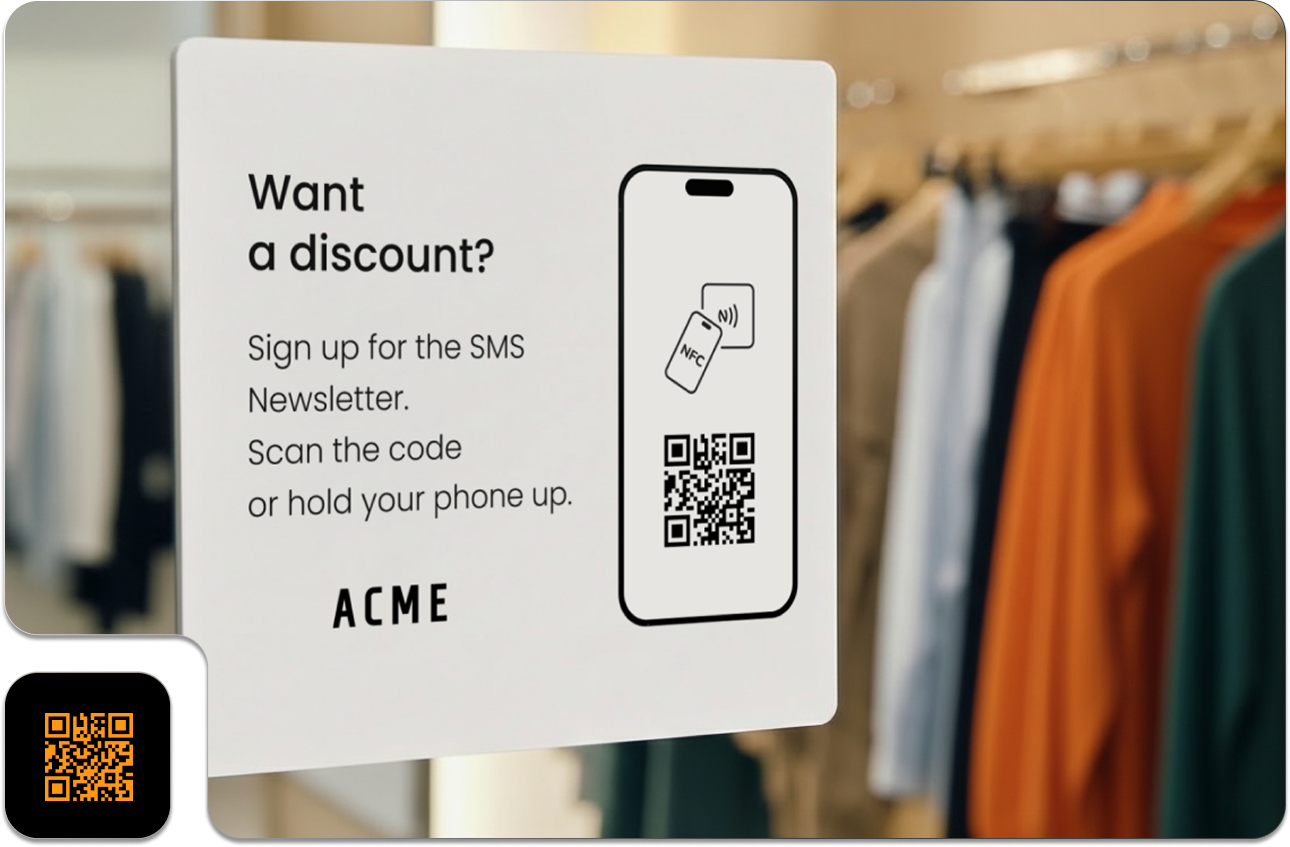
A QR code runs through the same flow in environments where it fits better. A window display, a product shelf, a receipt, a bag. The format is less immediate than NFC but works across a wider range of physical surfaces. Each code carries a unique identifier, so the brand knows exactly which location or touchpoint generated each sign-up. The fitting room performed differently from the entrance display. The Saturday crowd behaved differently from the weekday one. That data exists and it is usable.
The key distinction is what the sign-up asks for. A phone number. Nothing more. The customer does not create an account. They do not set a password. They do not fill in a profile. They confirm a single piece of information and receive something in return, usually a discount code, delivered before they reach the door.
Around 95 percent of people who start this flow complete it. The best-performing retail locations average 30 verified sign-ups per day. Some reach 60.
What a verified contact makes possible
The phone number that enters the database at that moment is a direct line. Not to an inbox competing with hundreds of other senders. Not to a feed governed by an algorithm. To a lock screen.
Over 90 percent of messages sent to a verified mobile number are opened. Most are read within three minutes of delivery. The channel has a directness that email has not had for years, not because email stopped working, but because the volume of email made attention scarce in a way that mobile messaging has not yet replicated.
The follow-up flow that follows the sign-up is where the conversion gap closes. A customer who left without buying receives a message the same day. The code they were given can be tracked individually. If it sits unused, a reminder goes out after a few days. Each message, each click, each redemption is recorded at the contact level. A store visit that previously generated no data now has a traceable line to a purchase outcome.
This is the re-reach path that physical retail has been missing. Not a loyalty programme, not an app, not a win-back email sent three days later. A direct, verified, low-friction contact collected at the highest-intent moment in the customer journey, and a follow-up mechanism that treats the store visit as the beginning of a sequence rather than its conclusion.
The broader shift
The brands seeing the strongest results from this approach are not replacing their existing customer relationship tools. They are adding a contact collection layer that works earlier in the funnel, before the customer has committed enough to download an app or fill in a form.
Loyalty programmes are built for customers who have already decided. The undecided visitor needs a different entry point. One that matches their level of commitment at that moment, which is high enough to hand over a phone number, but not high enough to spend five minutes on registration.
The in-store visit is still one of the highest-intent interactions a retail brand will have. The customer chose to be there. They gave time and attention that no paid ad can reliably buy. That is the moment 2way is built for, and that's how you can turn foot traffic into extra revenue.
Frequently Asked Questions
Why do customers leave a store without buying even when they are interested?
The reasons are usually practical and temporary: the right size was not available, the queue was long, or they wanted more time to decide. The problem is not the barrier itself but that most brands have no way to follow up once the customer has left.
What is the difference between NFC and QR for in-store sign-ups?
NFC requires the customer to hold their phone close to a tag, which makes the interaction faster and requires no camera. QR codes work across a wider range of surfaces, including window displays, receipts, and packaging, but require the camera app. Both run through the same sign-up flow and both assign a unique identifier to each location, so performance can be measured per touchpoint.
Why ask only for a phone number and not a full registration?
The sign-up moment happens before the customer has committed to the brand. A full registration form, with name, email, password, and profile details, is designed for someone who has already decided. A phone number and a one-time verification code match the level of commitment a first-time visitor is actually willing to give. That is why completion rates for this flow reach around 95%.
How is a verified phone number different from an email address for follow-up?
A verified mobile number delivers messages directly to the lock screen, with no competition from promotional folders or algorithmic filters. Over 90% of messages sent to a verified number are opened, and most are read within three minutes. Email open rates across the industry sit at 15 to 25%.
Does this approach replace a loyalty programme?
No. Loyalty programmes work well for customers who have already committed to the brand. This contact collection layer works earlier, capturing visitors who are still deciding. The two serve different stages of the customer relationship and are designed to work alongside each other.
Similar Posts



in the database
purchased online
before
usage
AVERAGE BASKET VALUE