
A step-by-step guide for e-commerce teams
Every e-commerce site produces a signal of customer intent on every visit. Scrolling through a product description, pausing on the cart, returning to a page for a second look: each of these moments tells the brand that someone is paying attention. The opportunity is to capture that attention in a form the marketing team can use later.
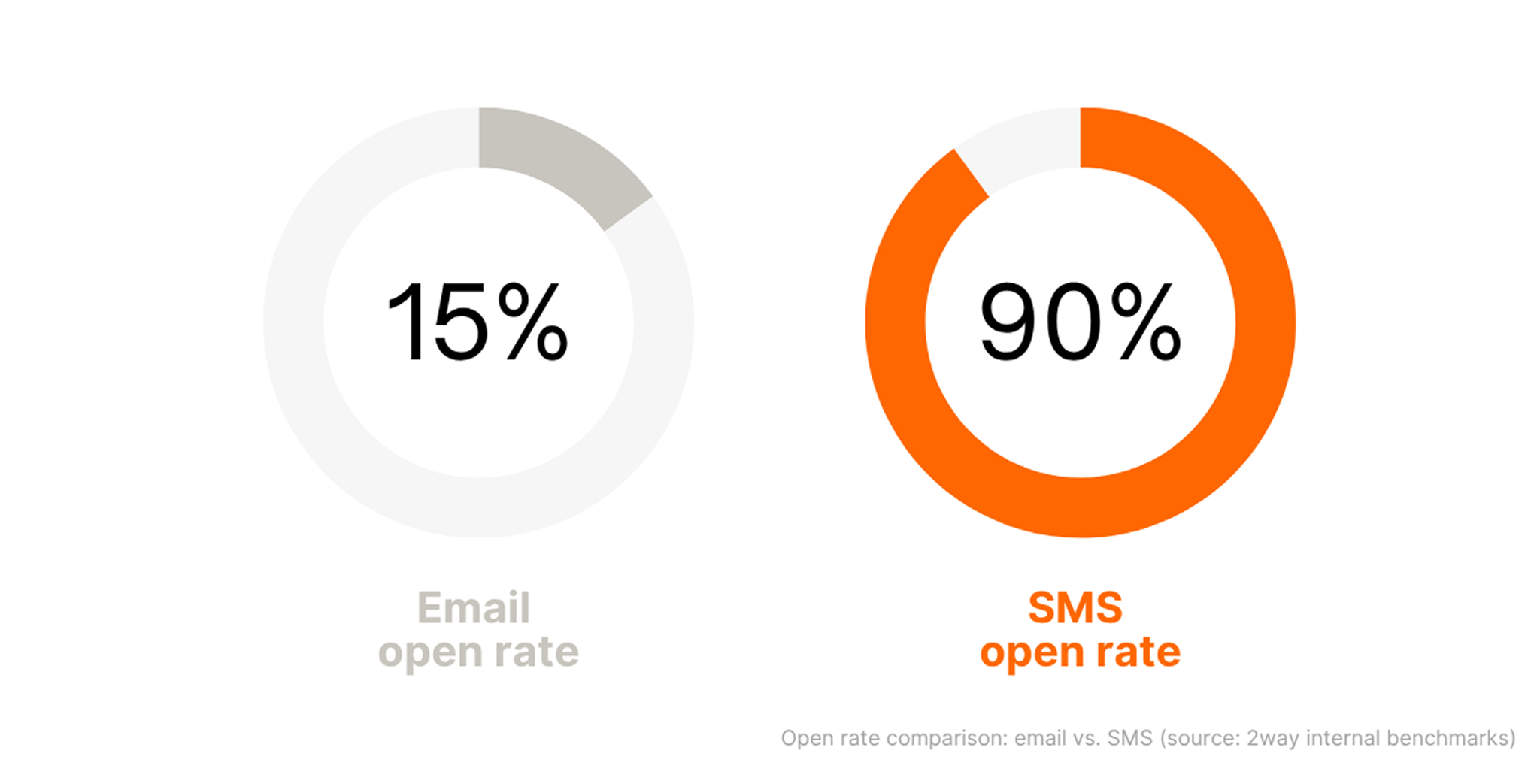
A verified phone number captured at one of these moments gives the brand a direct channel to the customer. Short message service (SMS) delivers open rates above 90 percent, compared to 15 to 20 percent on email. The shift is not in how the campaign is written. The shift is in what kind of audience the campaign reaches.
This is the role of 2way Grow. A teaser and a popup, placed on pages where intent is visible, collect verified phone numbers in exchange for a tracked discount code. The contact base that results delivers 90 percent plus SMS open rates and a direct line to the customer that the brand owns end to end.
The opportunity sits upstream of the campaign
Campaign performance is shaped by the quality of the audience receiving it. A base built from verified opt-ins, where each contact picked the channel they want to hear from, behaves differently from a base assembled from checkout email fields. The same offer, the same creative, the same send time, routed to a verified base, produces numbers the team can plan around.
SMS open rates sit above 90 percent when the base is built this way. 95 percent of SMS messages are read within three minutes. Click-through rates on SMS range from 5 to 30 percent, compared to 1 to 2 percent on email. These are channel figures, and they become reproducible once the audience behind them is collected and verified by design.
The move is to build the base deliberately. Verify numbers at sign-up. Let the customer pick the channel they want to hear from. Tie every opt-in to a measurable outcome from day one. Every metric downstream becomes easier to move because the foundation underneath it was built for reach.
1 Catch visitors when they are paying attention
The opt-ins that produce the strongest follow-up results come from visitors who are already close to buying. Someone considering a product, pausing on the cart, or leaving a high-value page is a customer who has shown interest. Capturing a contact at that moment gives the brand a verified phone number tied to clear intent.
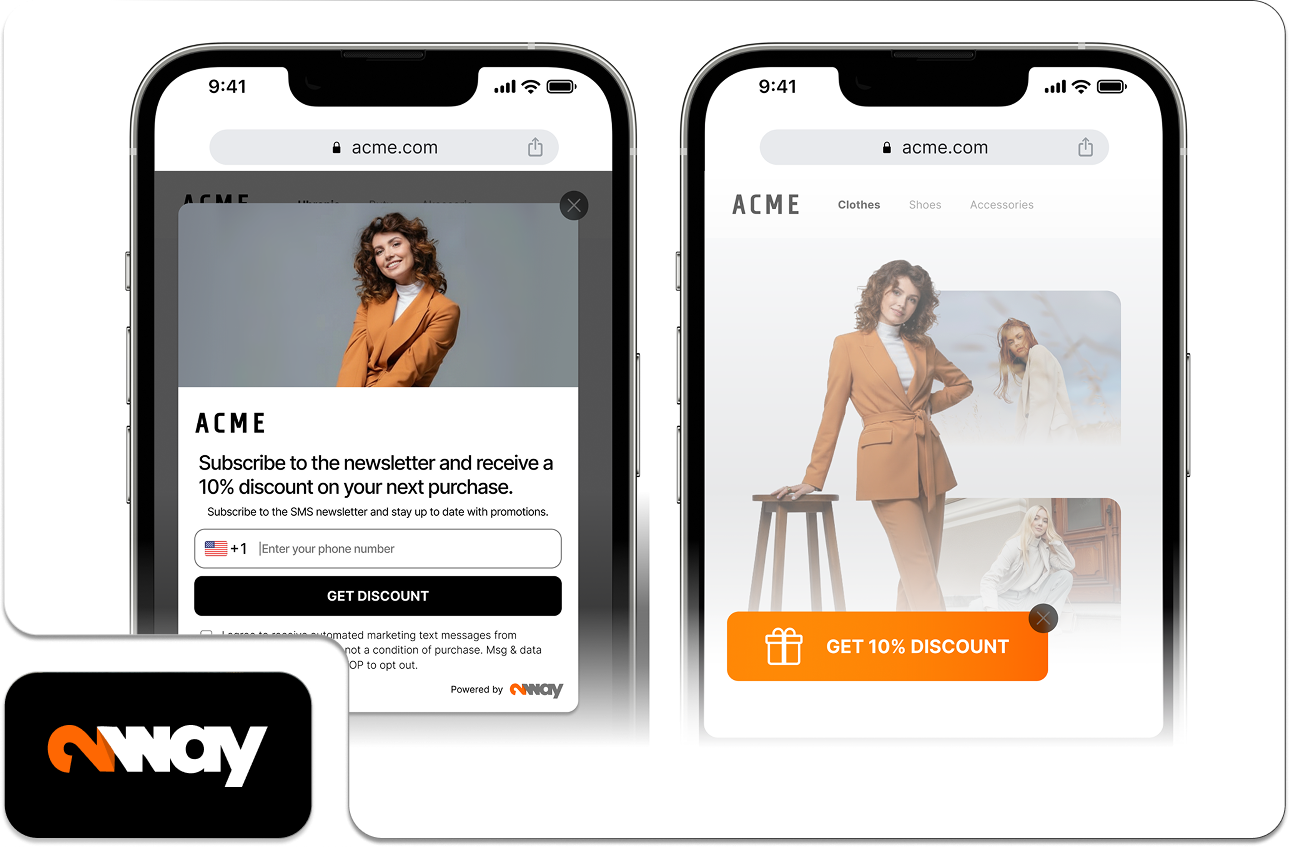
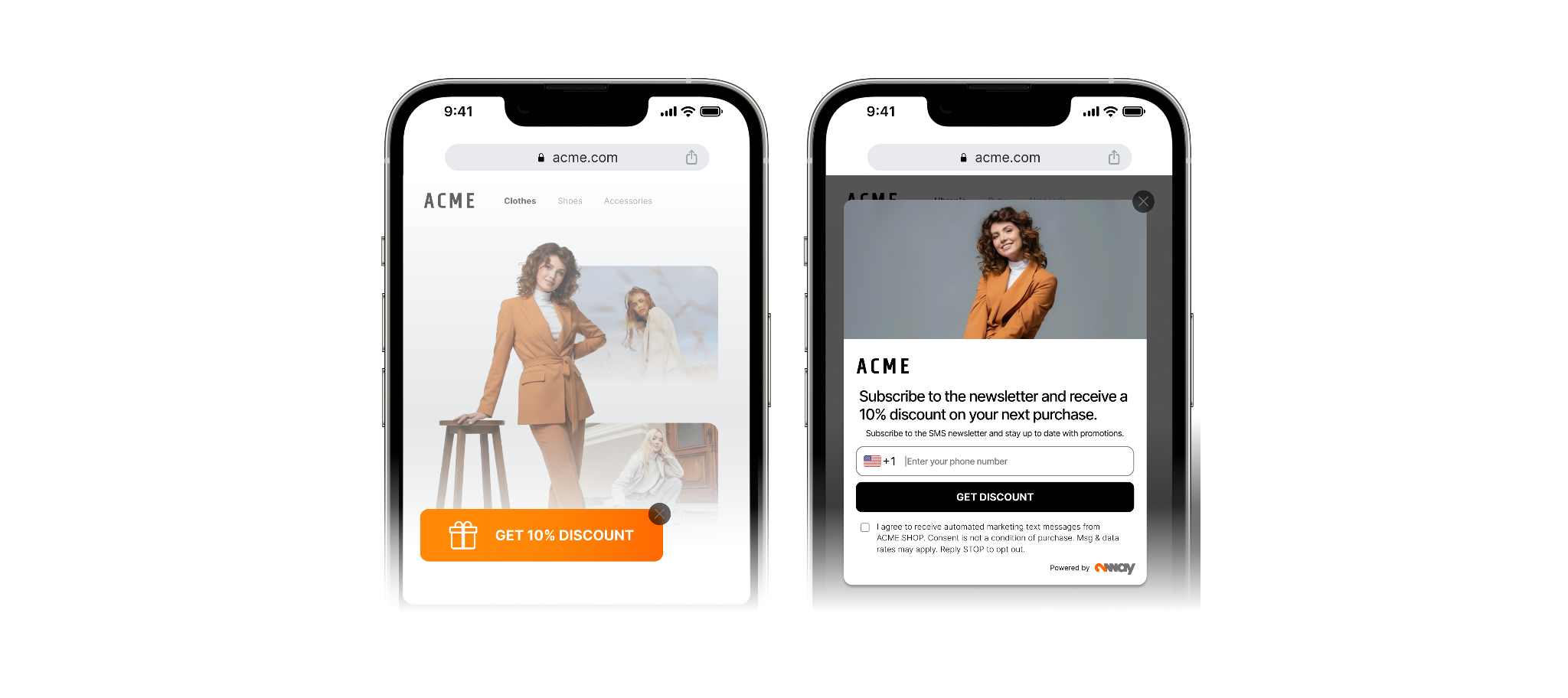
2way Grow does this with two elements working together. A teaser sits quietly on the page, visible but not disruptive. A popup activates at the moments where intent is strongest: deep scroll on a product page, pause on the cart, or an exit signal on a high-value page. The teaser keeps the offer in view for browsing visitors. The popup closes the opt-in when the signal is clear.
Three placements are enough to start: product page, cart, and exit. These are the pages where the measurable volume comes in, because they are the pages where the visitor is close to a decision.
2 Keep the opt-in short and the base verified from entry
A short opt-in protects conversion. A verification step at sign-up protects everything that happens after. 2way Grow combines both: the full flow is built to stay short, and every contact is verified before it enters the database.
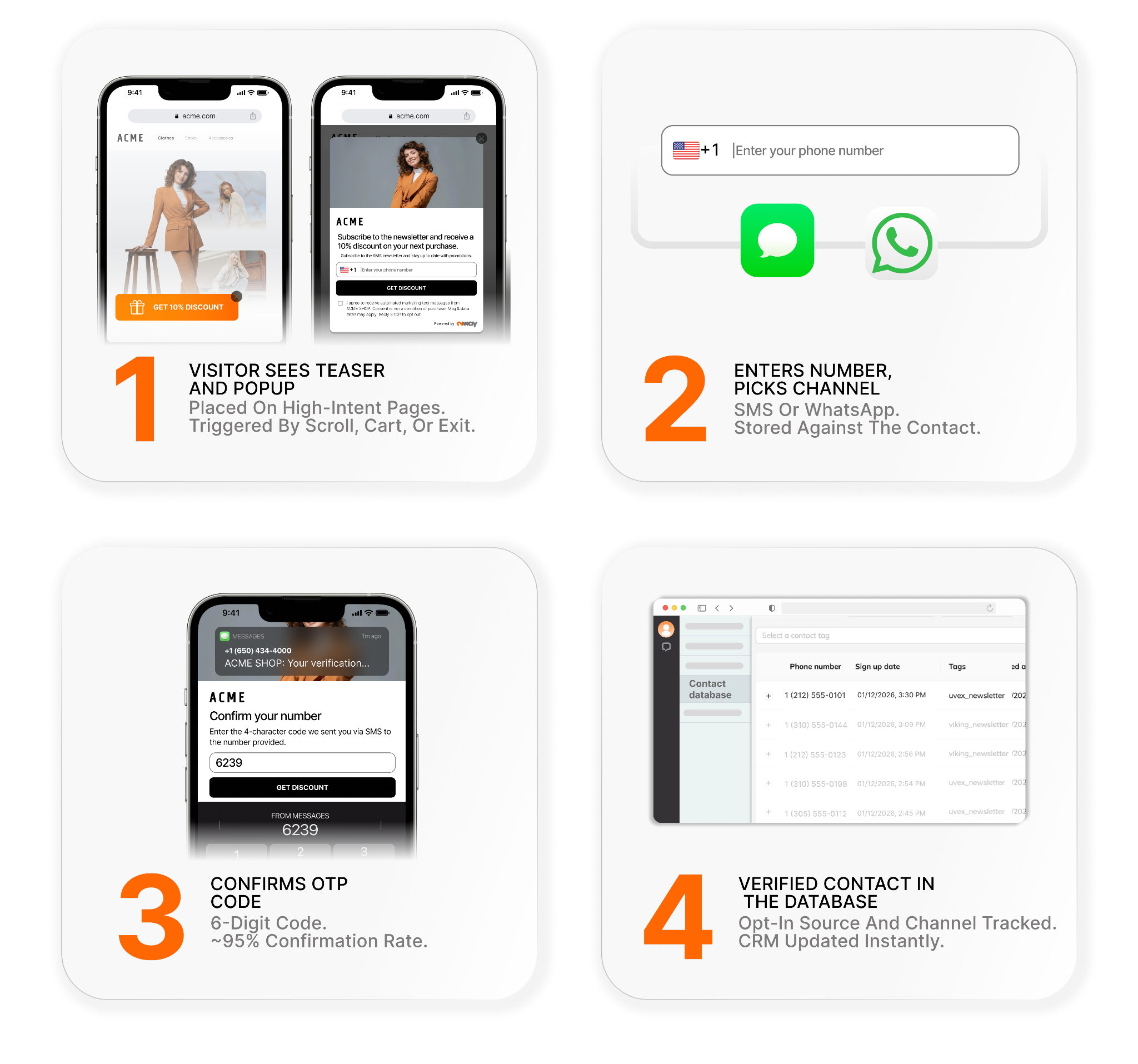
The visitor enters a phone number, picks SMS or WhatsApp, and confirms a one-time passcode (OTP) sent to the device. That completes the sign-up. 95 percent of opt-ins complete the OTP step, which means the contact has confirmed the number is real and the device is in the hands of the customer at that moment. The base is verified at entry, which removes the need for a cleaning step later.
Standard implementation takes 48 hours using a template popup. A custom popup, matched to the brand and tested against the existing user experience, takes two to three weeks. Both versions include OTP verification, channel selection, consent records, discount code generation, and customer relationship management (CRM) integration.
3 Turn every opt-in into a revenue line you can track
A contact base is most useful when every entry is tied to a measurable outcome. With 2way Grow, that tie is built in from the moment the visitor signs up. Each opt-in receives a discount code unique to their contact record, and the code is tracked through every step: whether it was applied to the current basket, whether the customer returned in a later session to use it, and whether the order was completed. If the code goes unused, an automatic reminder goes out on the channel the customer chose.
This is what lets the marketing team show return on investment (ROI) at the contact level, not just the campaign level. Finance sees which contacts generated revenue, how quickly after opt-in, and through which channel. The channel justifies itself with figures the whole organisation can read.
Integration is the step that makes this tracking useful. When 2way Grow connects to the e-commerce platform and CRM at deployment, every verified phone contact links to an existing customer profile where one exists. The marketing team sees a unified record: phone number, preferred channel, consent history, order history, and discount code usage, visible in one place before the first campaign sends.
4 Let each customer pick the channel they actually use
Reach improves when each customer receives campaigns on the channel they use most. Some customers prefer SMS, others prefer WhatsApp, and the distribution varies by market. A base that captures channel choice at the individual level performs across every market the brand operates in, without the team having to make a market-level assumption.
The visitor makes the choice at sign-up by picking SMS or WhatsApp directly. The selection is stored against the contact record and applied to every campaign that follows. The marketing team gains reach because the customer has already answered the question.
For stores operating in more than one country, the same teaser and popup run on every regional site. Compliance rules are managed per country inside 2way Send. The brand deploys once, the contact base scales, and channel selection is handled at the level of the individual customer.
5 Use the first campaign to set a clear baseline
The first campaign to a newly built base is where the performance baseline gets set. A simple message with one offer and one tracked link delivers a clean result that every campaign after it can be measured against. The verified base is what makes the result reproducible: the second campaign performs the way the first one did, because the audience is stable in quality.
The numbers the base can support are already visible. SMS returns 8.6x ROI at an average order value (AOV) of $28. WhatsApp returns 8.0x at the same AOV. MMS returns 10.8x. 95 percent of SMS messages are read within three minutes. These are channel figures, and a verified base is what turns them into campaign results that hold month after month.
Every short link in the message is branded and tracked per contact. The team sees which individual contacts clicked, which converted, and which stayed silent. Segmentation for the next campaign is built from data rather than guesswork.
6 Keep the base reachable as it grows
A verified base is most valuable when it stays reachable over time. Phone numbers get reassigned, customers change devices, and a contact that verified the OTP in October may not be on the same number six months later. A system that tracks reachability continuously protects campaign performance as the database ages.
Delivery Health inside 2way Send runs this check before each send. The system scores contact-level reachability using native carrier signals. Standard delivery confirmation tells the team a message was accepted by the network after it was sent. Delivery Health tells the team whether the contact will receive it before the campaign goes out, which means campaign metrics reflect the audience the brand actually reached.
There is a compliance advantage in how Delivery Health works. Because it relies on carrier signals rather than tracking pixels or third-party data, it stays compliant with the General Data Protection Regulation (GDPR) and equivalent regulations across the 180 countries where 2way Send operates. Database quality is protected without adding a manual cleaning workflow.
Where to start
Deployment times are short. A template teaser and popup go live in 48 hours. A custom design, adapted to the brand and tested against the existing site, takes two to three weeks. Both paths deliver the same core stack: OTP verification, channel selection, consent documentation, discount code generation, and CRM integration.
Placement is where the first planning decision sits. Pick two or three moments on the site where intent runs highest: typically the cart, an exit trigger on a high-value page, and one product page placement. Run the setup for 30 days against a clear baseline. Expand from what worked.
The base that results from this process gives the brand something an email list exported at checkout cannot: every entry was verified at sign-up, picked the channel the customer wants to use, and joined in exchange for something concrete. That is the foundation that lifts the baseline for every campaign that follows.
See how 2way Grow and 2way Send support this process end to end.
Frequently Asked Questions about Turning Website Traffic into a Reachable Contact Base
Why does a verified phone contact produce better campaign results than an email address collected at checkout?
An email address collected at checkout is often a secondary inbox, an address set aside for promotional mail, or one entered quickly with no intent to engage. A verified phone number confirms that the number is real, the device was in the customer's hands at sign-up, and the contact chose to be there. That difference in quality is what produces SMS open rates above 90%, compared to 15 to 20% for email, on the same offer sent to the same audience.
Which pages on an e-commerce site produce the highest quality opt-ins?
Product pages at deep scroll, the cart page, and exit moments on high-value pages. These are the points where a visitor has already demonstrated interest: they are considering a product, reviewing their basket, or about to leave after spending meaningful time on the site. A contact captured at one of these moments carries stronger purchase intent than one collected through a generic homepage form.
What is the difference between a teaser and a popup in this context?
A teaser sits quietly on the page without interrupting browsing, keeping the offer visible for visitors who are not yet at a decision point. A popup activates when a specific signal appears: deep scroll on a product page, a pause on the cart, or an exit trigger. The two work together: the teaser maintains visibility across the session, and the popup closes the opt-in at the moment intent is strongest.
How does connecting 2way Grow to a CRM change what the marketing team can see?
Without CRM integration, a new phone contact is an isolated record. With integration, the verified phone number links to any existing customer profile, combining phone number, preferred channel, consent history, order history, and discount code usage into one record visible before the first campaign sends. That unified view is what allows the team to measure return on investment at the contact level rather than only at the campaign level.
How does the base stay reachable as it grows over time?
Phone numbers are reassigned and customers change devices, so a contact verified at opt-in may not be reachable on the same number months later. Delivery Health inside 2way Send scores contact-level reachability using native carrier signals before each campaign sends. Unlike standard delivery confirmation, which reports whether a message was accepted by the network after sending, Delivery Health identifies unreachable contacts before the campaign goes out, protecting campaign metrics and preventing budget from being spent on contacts that will not receive the message.
More from the blog



See what your own stores would collect
We'll set up a pilot placement in one of your locations and show you the verified contacts it produces, before you commit to anything wider.
