
SMS click-through rates run from 5 to 30%, against 1 to 2% for email. 95% of messages are read within three minutes of delivery. These are channel-level numbers, and they describe attention that mobile messaging holds by default. They do not describe what any single send returns.
The distance between channel performance and campaign performance is closed at the message level. A converting message is built from a small set of decisions, and each one connects to a measurable business outcome: return per send, customer acquisition cost, and the long-term value of the contact base.
Why the Message Itself Decides Campaign Return
A campaign on a verified phone audience reaches the screen. That is the floor. The ceiling is set by what the message says, who it is sent to, and what action it asks for.
Three outcomes follow from the message itself.
Return per send rises when the audience is verified and the message is structured for a single action. The cost side is fixed and predictable on a verified list, so every additional dollar of revenue per send goes straight to return on investment (ROI).
Acquisition cost falls when the first message converts on the same campaign that pays for sign-up. A message that opens but does not click defers payback to a later send.
Brand permission is the third outcome and the most under-measured. Mobile messaging carries banking alerts, two-factor codes, and personal messages. Notifications stay active because silencing them has a real cost. Every send that respects that context extends permission. Every send that does not, reduces it.
The Four Elements of a Message That Converts
Four elements matter, in this order.
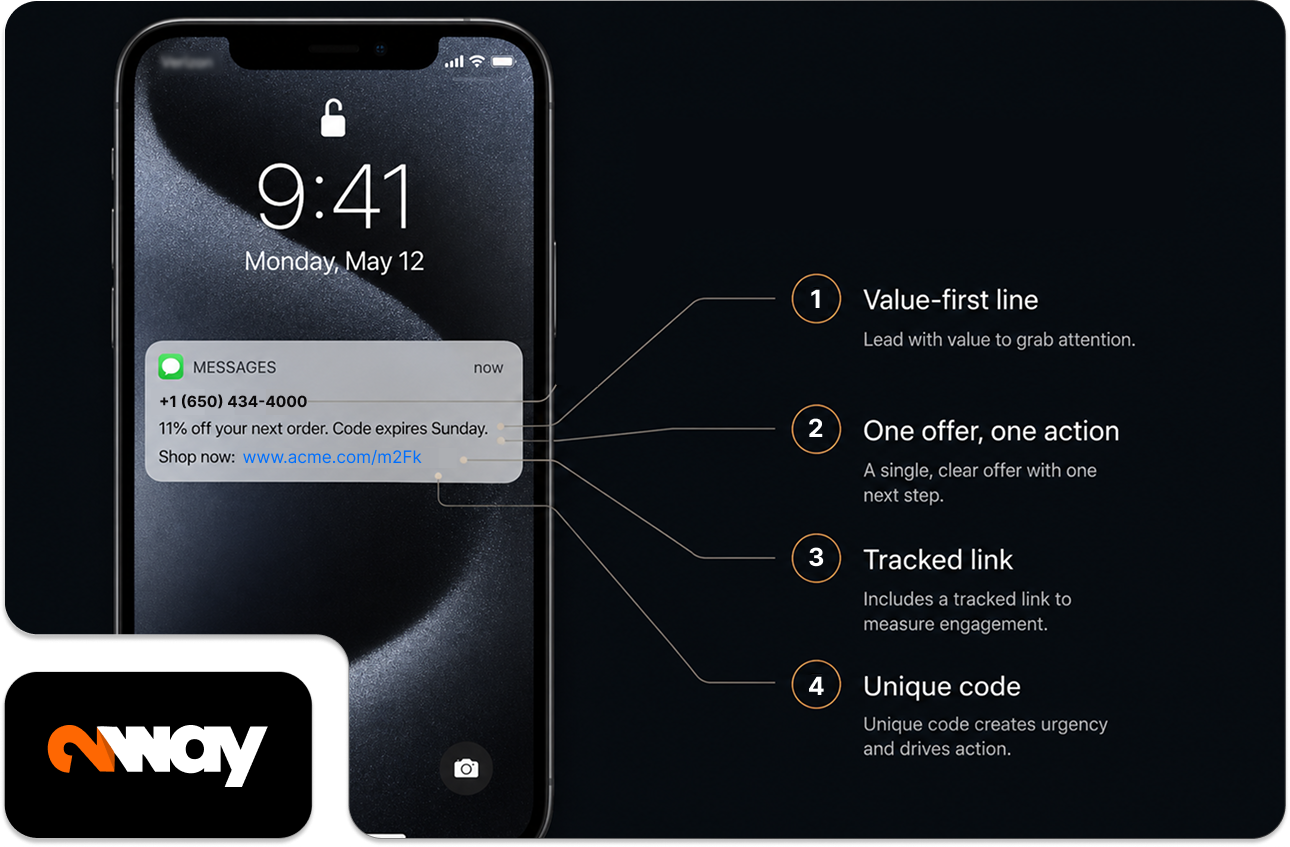
A first line that states the value. The opening characters of the message appear before the user opens anything. A first line that names the value directly ("11% off your next order. Code expires Sunday.") converts users who never read the full text.
One offer, one action. A 160-character message that names a single benefit and points to a single link outperforms a longer message that lists multiple offers. Attribution is also cleaner: results connect to a specific offer rather than a campaign average.
A tracked, branded short link. Every link in a 2way Send message is a branded short link with individual click tracking. The branding raises trust on the lock screen, and the tracking attaches every click to a specific contact, campaign, and offer. The result is revenue attribution at the contact level, from sign-up moment to completed order.
A unique discount code. Every contact collected through 2way Grow receives a unique code at the moment of sign-up. Redemption is tracked individually, repeat use is measurable, and a cohort of contacts can be valued in revenue terms over time rather than per single campaign.
Channel Selection: WhatsApp First, SMS Where It Wins
The same five elements apply on WhatsApp and SMS. The channel itself is a separate decision that depends on the market.
WhatsApp is the default in most regions. The format allows richer creative, supports two-way conversation, and carries higher engagement on average. SMS is the right channel where it is the cultural norm, where WhatsApp coverage has a documented gap, or where it serves as a fallback layer.
Across a global program, the answer is rarely one or the other. 2way Send manages routing automatically, with compliance windows and sender registration handled per country. One campaign brief produces sends that land on the right channel in every market.
Reachability Before Send: Delivery Health
A message can be perfectly written and still fail if it lands on a number that is not reachable.
Delivery Health is a contact-level engagement scoring system based on native carrier signals. It identifies which contacts are reachable before a campaign sends, without tracking pixels or third-party data, which keeps it compliant with the General Data Protection Regulation (GDPR).
The practical effect is budget protection. Unreachable contacts are flagged before the send rather than absorbed into the cost of the campaign. The campaign report reflects performance against an audience that could actually receive the message. This is the pre-send audience quality signal that email has never offered, and post-send signals in email have become noisier in 2026, which makes the difference larger now than it was three years ago.
What Compounds Across Messages
A single converting message is one campaign result. The strategic value compounds across sends.
The contact base grows in quality, not just size. Tracked links and unique codes add data to each contact record, and after three or four campaigns the base separates into segments based on real behavior.
Acquisition cost becomes more predictable. A higher share of contacts converting on early sends lowers the blended cost across the program.
The audience becomes an owned asset. A verified, OTP-confirmed, reachable, behaviorally segmented contact base does not disappear when a budget cycle ends. It can be valued per campaign and carried between providers without losing the consent record.
What 2way Brings to the Picture
2way builds the verified audience through 2way Grow, sends the campaigns through 2way Send with Delivery Health and per-country compliance, and produces multilingual creative through 2way Studio. The platform operates in 180 countries and works alongside an existing CRM. Standard technical setup takes 48 hours.
To see what a converting message looks like on a specific audience and offer, contact the 2way team.
FAQ
What makes an SMS message effective?
Four elements in this order: a first line that states the value, since the opening characters appear on the lock screen before the message is opened; one offer and one action per message, since multiple offers reduce conversion and confuse attribution; a tracked, branded short link that attaches every click to a specific contact and campaign; and a unique discount code per contact that turns redemption into a measurable revenue line.
How long should a marketing SMS be?
A 160-character message that names a single benefit and points to a single link consistently outperforms a longer message that lists multiple offers. The discipline is one offer, one action. Attribution stays clean too, since results connect to a specific offer rather than to a campaign average.
What is the click-through rate for SMS?
SMS click-through rates run between 5 and 30 percent depending on vertical, against 1 to 2 percent for email. The gap is widest on time-sensitive offers, where the short, direct format prompts immediate action. The performance depends on audience quality: a verified, opted-in base produces these rates consistently, while an unverified list pulls the average down.
Should I use SMS or WhatsApp for marketing?
WhatsApp is the default in most regions because the format allows richer creative, supports two-way conversation, and carries higher engagement on average. SMS is appropriate where it is the cultural norm, where WhatsApp coverage has a documented gap, or where it serves as a fallback layer. Across a global program, the answer is rarely one or the other; routing is decided per market.
How do you know if SMS contacts are still reachable?
By scoring reachability before the send, not after. Standard delivery confirmation tells the team a message was accepted by the network after it was sent. A pre-send reachability check, built on native carrier signals, identifies which contacts will receive the message before the campaign goes out. Spend moves to contacts the message will reach, and the campaign report reflects performance against an audience that could actually be reached.
More from the blog

See what your own stores would collect
We'll set up a pilot placement in one of your locations and show you the verified contacts it produces, before you commit to anything wider.
