
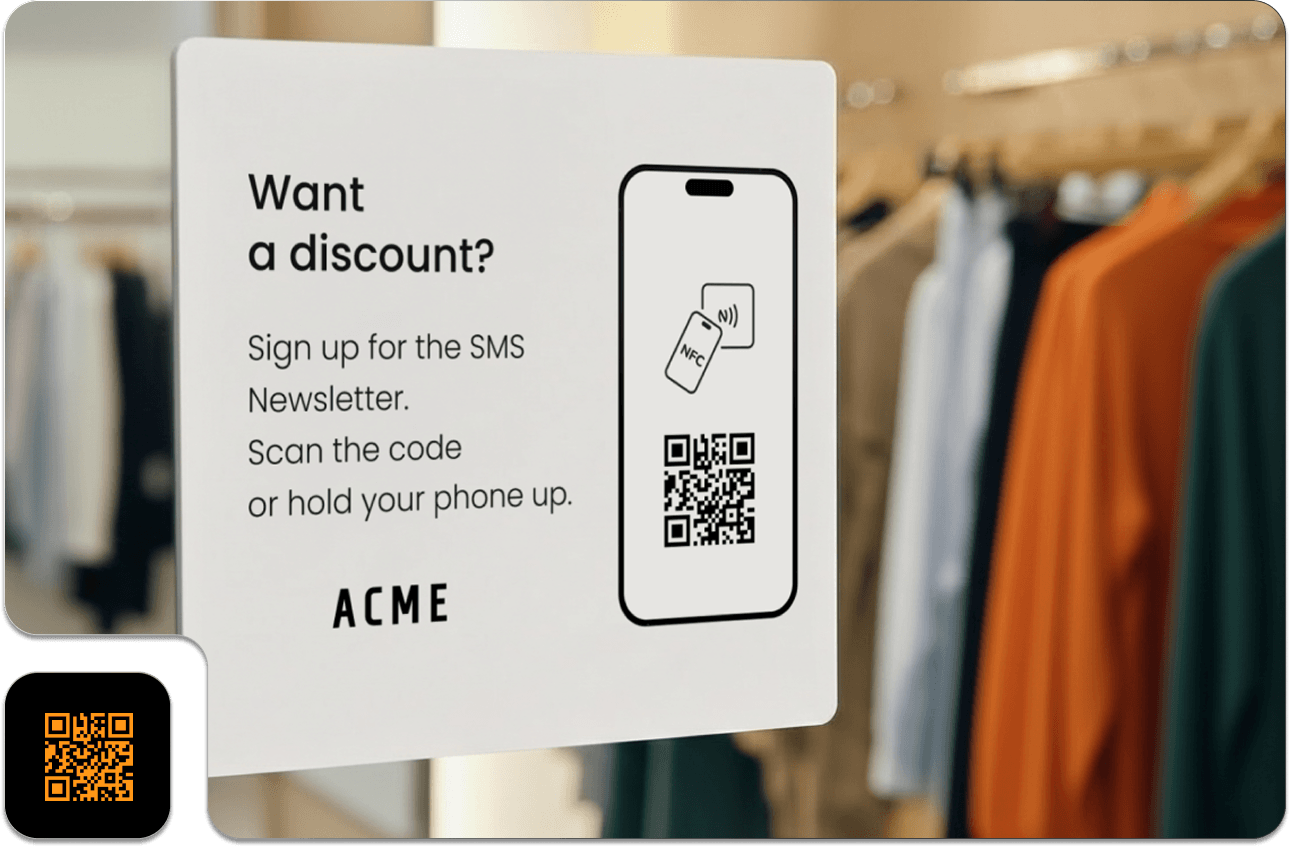
Every day, people walk past your poster, pick up your flyer, or visit your stand. They look. Some are interested. Then they leave, and you have no idea who they were.
A QR code changes that. One scan connects an anonymous person standing in front of your materials to a verified contact in your database. No typing, no friction, no staff required. The conversion happens in under 30 seconds, and the lead is yours before they walk away.
This guide covers how to build that flow, why people scan in the first place, and what to do with the contact once you have it.
What Is QR Code Lead Generation?
QR code lead generation is the process of using a scannable code to move someone from a physical environment into a digital sign-up flow. The mechanism is straightforward:
- A person scans the code with their smartphone camera
- They land on a page with a short form, typically a phone number field and a benefit statement
- They enter their details and confirm with a one-time verification code
- They receive something of value immediately: a discount, a resource, access to an offer
- Their verified contact enters your database, tagged with the source that generated it
The reason this works at scale is not the technology. It is the context. A person standing in front of a physical object, whether a store sticker, an event stand, or a product package, already has their phone in their hand. The scan requires one gesture. The form requires one field. The barrier between intent and action is as low as it can be.
Compare that to asking someone to visit a website, find the sign-up form, type in their email address, and wait for a confirmation. By the time they sit down to do it, the moment has passed.
QR code lead generation captures the moment while it exists.
The Psychology of the Scan: Why People Actually Do It
Understanding why someone scans a QR code is more useful than optimising the code itself. The technology is not the variable. The human decision is.
Three psychological mechanisms determine whether a person scans or walks past.
Curiosity and immediacy
A QR code with no context gets ignored. A QR code with a specific, concrete promise attached to it triggers curiosity. "Scan for 20% off your first order" is not a mystery: the person knows exactly what they will receive and can evaluate whether it is worth 30 seconds of their time. The specificity removes the risk of the unknown and replaces it with a clear value calculation.
The immediacy of the reward matters as much as its size. A discount delivered to the phone within seconds of scanning converts better than the same discount promised by email in 24 hours. The person is standing in front of the offer right now. The reward needs to arrive right now too.
Reciprocity
When a brand offers something of genuine value before asking for anything in return, the psychological principle of reciprocity increases the likelihood of compliance. A free guide, an exclusive discount, early access to a sale: these are not just incentives. They are signals that the exchange is fair.
A person who receives something useful before being asked for their phone number is more likely to provide it than someone who is asked cold. The sequence matters: value first, ask second.
Low perceived risk
A phone number feels more personal than an email address. Most people have one primary number and use it for everything important. Asking for it requires more trust than asking for an email.
Two things reduce the perceived risk of leaving a number. First, a clear explanation of what they are signing up for: what they will receive, how often, and how to stop. Second, the sign-up mechanism itself: a double opt-in that confirms the number belongs to them and documents their consent. The verification step is often perceived as a security feature by the person completing it, which increases rather than decreases trust.
The Incentive: Why Nobody Scans for Nothing
The incentive attached to a QR code is not a nice addition. It is the reason the scan happens at all.
The most effective incentives share three characteristics:
- Immediate delivery. The reward arrives by SMS within seconds of the scan, not by email the following day. The person is standing in front of your materials right now. That window closes the moment they move on.
- Specificity. "Exclusive offer" is not an incentive. "15% off your next purchase, valid for 7 days" is. The person needs to know what they are getting before they decide whether it is worth their phone number.
- Relevance to the context. An incentive that connects to the environment where the scan happens converts better than a generic offer. A discount on the specific product displayed next to the QR code outperforms a generic sitewide promotion, because it is relevant to what the person is already looking at.
The individual discount code is the most effective retail incentive format because it serves two purposes simultaneously. For the customer, it is a personal reward that feels different from a mass promotion. For the brand, it is a tracking instrument: the code records whether it was used, when, on which product, and for what order value. That data is what connects the QR code scan to a revenue outcome.
5 Use Cases for QR Code Lead Generation
1. Retail stores
A QR sticker placed at the checkout counter, fitting room, or product display turns the highest-intent moments in the customer journey into sign-up opportunities. The customer is already engaged with the product. The scan takes seconds. The discount arrives before they reach the door.
Retail is the environment where QR lead generation produces the most consistent volumes. Checkout stickers in 2way deployments average around 30 verified sign-ups per day per placement point, with the best-performing locations reaching 60.
2. Events and conferences
An event stand is a one-time environment. The person in front of you is there for a specific window of time, and when they leave, the opportunity to capture their contact closes. A QR code on stand materials, at the entrance, or on printed collateral converts a single interaction into a lasting digital relationship.
The incentive at events works differently from retail. A discount is less relevant at a B2B conference than a practical resource: a guide, a template, access to session recordings, or a follow-up consultation. The offer should match the context and the professional intent of the audience.
3. Printed materials and direct mail
A flyer, a brochure, or a direct mail piece is static by default. It communicates, but it cannot capture. A QR code turns a passive piece of print into a measurable lead generation channel.
Each printed material can carry its own unique QR code, which means the brand can compare performance across different formats, distribution locations, and campaigns. The poster in the shopping centre and the flyer enclosed with an order both carry their own identifiers, and the analytics panel shows exactly which generated more contacts.
4. Real estate
A property listing board outside a house is seen by everyone who walks or drives past. Most of them are potential buyers or renters at some stage of consideration. A QR code on the board that leads to a sign-up form, offering property details, a virtual tour, or an alert when similar properties become available, converts that passive impression into a warm lead for the agent.
The real estate context is well suited to QR lead generation because the intent of the person scanning is already high. Someone who stops to photograph a property listing and scans a QR code is not a cold contact. They are a qualified prospect who self-identified by taking an action.
5. Out-of-home advertising
A billboard, a bus stop poster, or a digital display reaches a large number of people but historically produces no measurable outcome. A QR code changes that. The passerby who scans moves from an impression to an identified contact in a single action.
Out-of-home QR codes work best with a very short, high-value incentive statement visible from a distance. The person scanning is often moving, which means the call to action needs to be readable in one glance and the landing page needs to load in under three seconds. Simplicity is not optional here: it is the condition for the scan happening at all.
How to Optimise Your QR Code Campaign for Conversion
The scan is only the first step. What happens between the scan and the verified sign-up determines whether the lead is captured or lost.
The landing page must be built for mobile
Every person who scans a QR code is on a mobile device. The landing page they reach must load in under three seconds, display correctly on a small screen, and contain only what is necessary: one phone number field, one benefit statement, and one button. Navigation menus, links to other pages, secondary offers, and extended brand descriptions all reduce conversion at the moment the person is closest to signing up.
The call to action does the selling
The text printed next to a QR code determines whether it gets scanned. "Scan me" is an instruction. "Scan for your 15% discount code" is a reason. The call to action must answer the question the person is silently asking: what do I get if I do this?
Benefit-led language consistently outperforms command language. Be specific about the reward, specific about the delivery method, and specific about the time frame if one applies.
Placement affects conversion as much as design
A QR code in the wrong location produces no results regardless of how well it is designed. The principles that determine effective placement:
- Eye level for a standing adult is the optimal height for most surfaces
- The area around the code must have reliable mobile signal: basement locations, underground spaces, and areas with poor coverage produce scans that fail to load, which damages trust and reduces future scan rates
- The quiet zone, the blank margin surrounding the code, must be preserved in print: cutting into it during production causes scan failures
- Minimum print size is 2 by 2 centimetres for close-range indoor scanning; outdoor and large-format placements should be larger
Use dynamic codes, not static ones
A static QR code encodes the destination URL directly into the pattern. Once printed, it cannot be changed. A dynamic QR code points to a redirect URL that can be updated at any time without reprinting the physical material.
Dynamic codes also enable tracking. Every scan is recorded: how many, from which device type, at what time of day, and from which geographic location. That data is what connects a physical placement to a measurable outcome and makes budget decisions for offline channels evidence-based rather than estimated.
Tracking, Attribution, and What Happens After the Scan
A QR code that captures a lead but connects to nothing is a missed opportunity. The contact entered the database. The relationship has not yet started.
The individual identifier assigned to each QR code is the foundation of the attribution model. In 2way, every code carries a unique tag that records the source of each sign-up: which sticker, which location, which campaign. A brand running QR codes across 10 store locations and three outdoor placements sees each one as a separate data point in the analytics dashboard. That granularity is what makes offline lead generation comparable to digital campaign reporting.
The contact data flows into the connected CRM automatically through webhooks and API, with no manual export required. Each verified phone number links to an existing customer profile where one exists, combining the new sign-up with purchase history, channel preference, and previous campaign interactions into a single record.
What happens next is where the investment in lead capture pays off:
- A welcome SMS delivers the promised incentive within seconds of sign-up, confirming the contact and setting expectations for future communication
- An unused discount code triggers an automated reminder at 7 days and again at 21 days, recovering conversions that would otherwise be lost
- A contact who clicked a link but did not purchase receives a targeted follow-up with a different angle on the same offer
- A contact inactive for 45 or more days enters a reactivation sequence with a time-limited exclusive offer
The QR code opened the channel. The SMS flow is what converts the contact into a customer.
Summary
A QR code placed in the right location, with the right incentive and a frictionless sign-up flow, is the shortest path between a person standing in front of your materials and a verified contact in your database. The technology is widely available and requires no hardware investment beyond a printed sticker. The mechanism works in a retail store, at an event stand, on a property listing board, or on a flyer enclosed with an order.
What determines whether it produces results is not the code itself. It is the clarity of the offer attached to it, the speed with which the reward is delivered, and the quality of the follow-up that turns a new contact into a returning customer.
Start collecting leads from the physical environments you already operate in. The contacts are already there.
More from the blog


See what your own stores would collect
We'll set up a pilot placement in one of your locations and show you the verified contacts it produces, before you commit to anything wider.
